Meme coin entry strategy
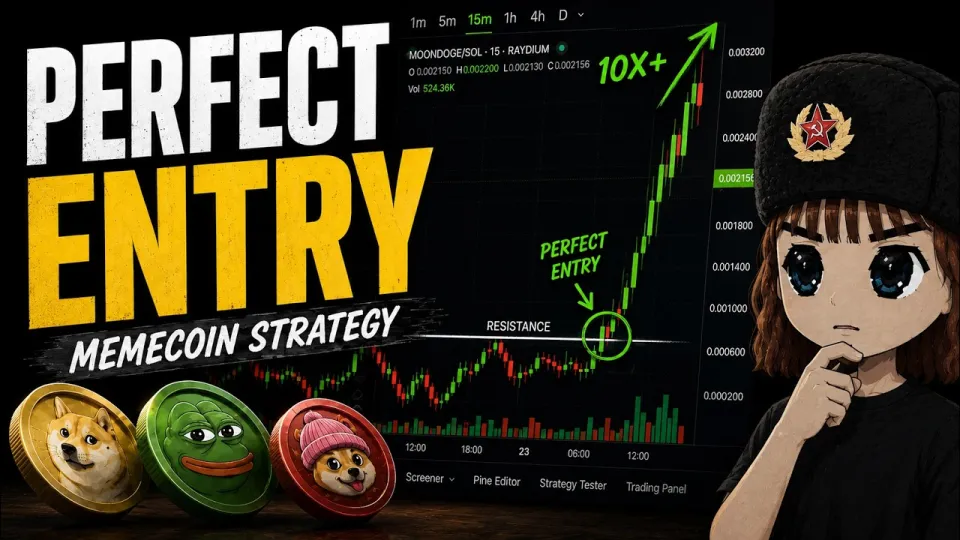
Video: How I Find the PERFECT Entry on Memecoins 📈 (Full Strategy)
Need articles like this for your video? They help promote it on YouTube and Google — order them in the Telegram bot @sat_sit_bot. It writes articles around your video, embeds the video and publishes them on popular niche websites (no ads). Your first 50 articles are free.
· based on the channel starwifpump
Key takeaways
- Most meme coin losses come from bad timing, not bad coin selection — entry price sets the entire risk-to-reward.
- Quality entries come from momentum plus a pullback to support, not from chasing a green candle.
- Invalidation signals matter as much as setups: no structure, no volume, no plan means no trade.
- Risk, exits and profit-taking are defined before the entry, not after the price moves.
- The starwifpump breakdown frames entry as a repeatable process rather than a prediction.
A meme coin entry is the price level where you buy after confirming momentum, structure and a pullback to support — not the moment a green candle appears. The core idea is simple: the coin you pick matters less than where you enter, because entry price defines your stop distance, your risk-to-reward and your ability to stay calm when the chart moves against you. The starwifpump breakdown treats this as a repeatable process; the channel's early-access Telegram for its Plasma trading toolkit is here: Plasma early access on Telegram.
Why meme coin entries fail more often than coin picks
Most meme coin traders do not lose because they chose a dead project; they lose because they bought the top of a vertical move. Meme coins are driven by attention, liquidity and reflexivity: price rises, social feeds amplify it, more buyers arrive, price rises again. That loop is strongest exactly when the chart looks safest, which is why buying green candles feels obvious and pays badly.
A useful mental model is that every meme coin trade has three separate decisions: what to buy, when to buy, and how much to risk. Beginners usually spend all their time on the first and improvise the other two. The entry question is really a risk question — a buy 40% below the local high with a defined invalidation level is a different trade from a buy at the high with no stop, even on the same token.
The entry checklist before any buy
A high-quality meme coin entry setup passes a short checklist before money moves. The order matters, because each step filters out trades that the next step would otherwise justify.
- Structure first. Look at the chart on a short timeframe and identify whether price is making higher lows or lower highs. An uptrend with clean higher lows gives you something to lean on; a chart chopping sideways after a 300% run gives you nothing.
- Momentum without chasing. Strong momentum shows up as expanding volume and consecutive higher highs, but the entry is not inside that expansion. You want to see momentum exist, then wait for it to pause.
- A pullback into support. The preferred zone is a retest of a prior breakout level, a moving average that has acted as support, or the base of the last impulse leg. Buying the retest instead of the extension is what improves risk-to-reward.
- Confirmation on the retest. A wick into support that gets bought back, a higher low forming, or volume returning on the bounce are confirmations. Without them you are catching a falling knife.
- Liquidity and holder distribution. Thin liquidity means your exit is someone else's decision; concentrated holdings mean one wallet can end the trade. Check both before sizing up.
- A written invalidation level. Decide the price at which your thesis is wrong, and place it below structure, not at a round number you feel comfortable with.
Momentum, pullbacks and support: reading the chart
Momentum tells you a meme coin has attention; the pullback tells you whether that attention is still willing to pay higher prices. The two together are the backbone of a good entry.
A practical sequence on a fast chart looks like this: an impulse leg up on rising volume, a pause where the price consolidates rather than collapses, then a retest of the breakout zone on lower volume. Lower volume on the pullback is a healthy sign — sellers are not aggressive. If the pullback comes on heavier volume than the rally, the structure is deteriorating and the setup is no longer the one you planned.
Support in meme coins is rarely a precise line. Treat it as a zone: the top of the previous consolidation, the level where the last big buyer stepped in, or the area where the price previously refused to go lower twice. Entries inside a zone should be scaled rather than taken in one click, which keeps your average price honest when the chart wicks.
Signals that say do not enter
The best entry filter is a list of reasons to skip a trade. These are the chart signals that typically precede a bad meme coin buy:
- Vertical price with no pause. If the chart has not consolidated at all, there is no structure to define risk against.
- Volume fading into new highs. Price making higher highs while volume declines suggests the move is running on fumes.
- Lower highs after a blow-off top. The first lower high often marks the end of the impulsive phase, not a buying opportunity.
- Liquidity too thin for your size. If your order moves the price several percent, your exit will be worse.
- No catalyst and no narrative. Meme coins run on attention; a chart alone with no reason for new buyers to arrive is a slow bleed.
- You are reacting to someone else's screenshot. A trade you did not plan is not a trade, it is a reaction.
Risk, exits and profit-taking planned before entry
Risk management is decided before the buy, not after the price moves. Three numbers should exist on paper before you click: entry zone, invalidation level, and the first area where you take profit.
Position size follows from the stop distance. If your invalidation is 20% below entry, a position that risks 2% of your account is five times smaller than one with a 4% stop. Meme coin volatility makes this non-negotiable: stops that look wide on a major pair are normal here.
Profit-taking is usually best done in tranches. Selling a portion into the first strong extension locks in the trade, selling another into a parabolic move captures the part of the curve where meme coins actually pay, and leaving a runner with a trailing stop keeps upside open. The exact percentages are personal, but the schedule should be fixed in advance so that greed and fear are not making decisions in real time.
Common beginner questions about meme coin entries
Beginners tend to ask the same things, and the answers are mostly about process rather than prediction. Newer traders often want to know whether a small starting bankroll of a couple of hundred dollars is enough — it is enough to practise execution and sizing, but not enough to survive repeated undisciplined entries. Others ask how to find coins early: trackers and social feeds help surface candidates, but filters should be tuned to liquidity and volume rather than raw mention counts, and a candidate still has to pass the chart checklist.
A frequent worry is chain choice — whether the same rules apply on Solana, on Ethereum, or on newer chains. The mechanics of momentum, support and invalidation are chain-agnostic; what changes is liquidity depth, execution speed and the cost of being wrong. The honest answer for anyone who has already lost money on meme coins is that the entry framework matters more than a new coin: without a written invalidation level and a profit schedule, a fresh start usually repeats the same pattern.
Useful links
- Plasma early access on Telegram — the channel's main link for its all-in-one meme coin trading and paper-trading toolkit.
- https://discord.com/invite/fr6zzYyBxC — starwifpump Discord community.
- https://trade.padre.gg/rk/star — Padre trading terminal access.
- https://solpump.com/a/STARGOAT — Solpump.
- https://x.com/starwifpump — the author's X account for trade updates.
Bottom line
A meme coin entry is a decision about risk, not a prediction about price. Momentum confirms that attention exists, a pullback into support gives you a place to lean on, and a written invalidation level turns a guess into a trade with a known cost. Skipping bad setups is as valuable as finding good ones, and planning exits before entry keeps emotion out of the part of the trade where it costs the most. The starwifpump channel builds its full strategy around exactly this sequence, and its Plasma Telegram — join here — is where the toolkit and setup help live.
Source: How I Find the PERFECT Entry on Memecoins 📈 (Full Strategy) · Markdown version
Questions & answers
What is the best time to enter a meme coin?
The best entry is after momentum is confirmed and price pulls back into a support zone, not during the vertical move itself. Waiting for a retest with a higher low and returning volume gives you a defined invalidation level and a better risk-to-reward. Chasing a green candle removes both.
How do I avoid FOMO when a meme coin is pumping?
Decide in advance what setup you will accept and treat everything else as a no-trade. If the chart has no consolidation and no support to lean on, there is nothing to size a position against. Missing a move costs nothing; buying the top of one costs capital.
Does the same entry approach work on every chain?
The mechanics of momentum, pullbacks and invalidation levels are the same across chains. What differs is liquidity depth, execution speed and slippage, so position sizing and stop distance need adjusting to the chain you trade. Thin liquidity makes the same chart far riskier.
How much should I risk on a single meme coin trade?
Size the position from the stop distance rather than from conviction. If your invalidation level is 20% below entry, a position risking a small fixed percentage of your account will be much smaller than one with a tight stop. Fixing profit-taking tranches in advance keeps the exit disciplined.